Authorized Signature Font: Elegant Handwritten Style for Crafters
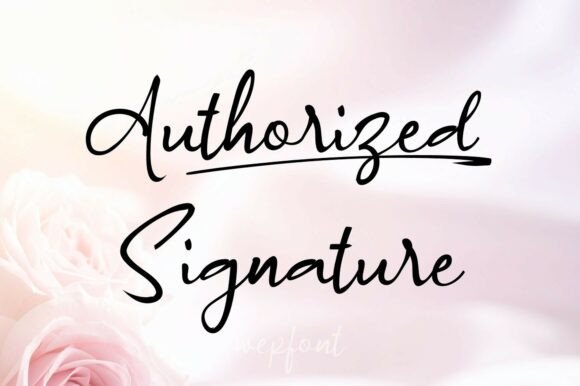
If you’ve ever spent hours tweaking a label, adjusting spacing on a wedding welcome sign, or testing how a font cuts on your Cricut—only to find it looks stiff, generic, or oddly pixelated—you’ll understand why Authorized Signature feels like finding the right brushstroke for a watercolor painting. It’s not just another script font. It’s an elegant, authentic, and sophisticated script typeface designed to mimic a genuine handwritten signature—fluid, intentional, and quietly confident.
What sets Authorized Signature apart is its balance of artistry and utility. The letterforms carry subtle variation in stroke weight, natural entry/exit flourishes, and graceful connections that read as human—not algorithmic. There are no exaggerated swirls or over-the-top swashes that distract from legibility. Instead, it offers refined charm: slightly tapered terminals, soft curves, and consistent rhythm across uppercase and lowercase characters. It feels personal without being cutesy, luxurious without feeling cold.
For crafters and small shop owners, this matters deeply. When your candle label says “Lavender & Sage” in Authorized Signature, customers don’t just read the scent—they feel the care behind it. When your printable planner page features “Today’s Intentions” in this font, it invites reflection rather than rushing. That’s the quiet power of a well-chosen display font: it shapes perception before a single word is processed.
Authorized Signature shines brightest in short-form, high-impact applications. Think: product tags, boutique gift box stickers, wedding place cards, greeting card headlines, mug quotes, tote bag monograms, farmhouse-style wall signs, holiday ornament labels, and digital download covers. Its design prioritizes clarity at sizes 18pt and up—so it holds up beautifully on printed cards, vinyl decals, and SVG cut files. For Cricut and Silhouette users, I recommend using the OTF version with OpenType features enabled to access built-in ligatures and stylistic alternates—especially helpful when cutting delicate flourishes cleanly.
Here’s where it gets practical: I use Authorized Signature for my seasonal printable collections—like “Cozy November” journal pages—and pair it with a clean sans serif (think Montserrat or Poppins) for body text. That contrast gives warmth *and* readability. For packaging, I combine it with a sturdy serif like Playfair Display for ingredient lists or brand names—creating hierarchy that feels intentional, not accidental. And yes—it works beautifully in logo design for handmade brands that want sophistication without sacrificing approachability.
It’s not meant for paragraphs. Don’t try to set a full invitation story or product description in Authorized Signature. But as a headline, title, name, monogram, or decorative phrase? Absolutely. I’ve used it for “Est. 2021” on wooden coasters, “Hand-Poured” on soy wax candle jars, and “You’re Invited” on foil-stamped wedding suites—with consistently strong results across print, web mockups, and physical goods.
Readability on small surfaces is thoughtful, too. At 12pt on a 1” sticker, the font remains legible if you avoid tight tracking and steer clear of ultra-thin weights (though Authorized Signature doesn’t include light variants—its single weight is optimized for impact). For tiny tags or jar labels, I often use just the first name or initial in Authorized Signature, then switch to a compact sans for supporting text. It keeps focus where it belongs—and avoids cutting issues on intricate loops.
The Script Amp collection includes Authorized Signature as a premium font asset, delivered in OTF and TTF formats with full Latin character support, standard ligatures, and positional alternates. No multilingual extensions, but it covers English, Spanish, French, German, and Portuguese diacritics reliably—enough for most craft-based product labels and digital downloads sold globally.
Pairing ideas that work consistently well: use Authorized Signature with Inter for modern printable templates, IBM Plex Serif for apothecary-style labels, or Work Sans for clean social media graphics and Etsy banner text. Avoid pairing it with other scripts—unless you’re intentionally layering for texture (e.g., a bold calligraphic “&” next to a delicate “Authorized Signature” monogram). Simplicity wins here.
Licensing is straightforward—and crucial. The commercial license covers physical products (stickers, mugs, shirts), digital downloads (PDF planners, Canva templates), SVG designs for craft cutting machines, client work, and even resale of editable templates. You do *not* need extended licensing to sell items made with Authorized Signature, as long as the font itself isn’t embedded in a way that allows end users to extract or reuse it (e.g., unflattened Illustrator files sold as editable assets). Always embed fonts in PDFs and outline text in SVG exports—that’s standard best practice, and it keeps your licensing compliant.
In real-world use, Authorized Signature has become my go-to for anything needing emotional resonance: baby milestone cards (“First Steps”), boutique soap labels (“Oat + Honey”), holiday ornaments (“Made With Love, 2024”), and even small-batch hot sauce branding (“Smoked Chipotle”). It adds polish without pretension—exactly what handmade customers respond to.
It’s not flashy. It doesn’t shout. But when your customer picks up a package and sees their name written in Authorized Signature on a ribbon tag—or notices how perfectly “Thank You” flows across a thank-you card—they feel seen. That’s the difference between decoration and connection. And for crafters building something real, that’s worth every pixel, cut line, and carefully kerned space.